Brand Loyalty Doesn't Survive Customs: A Dubai Paint Shopping Guide for Americans

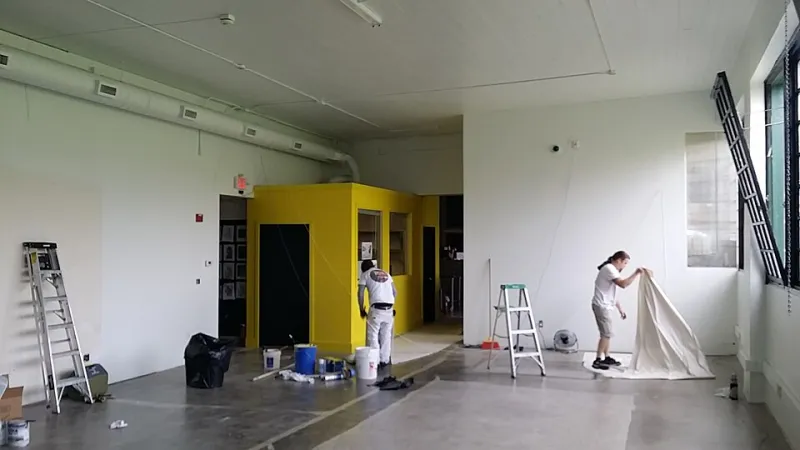
Photo: Marsupium, CC0, via Wikimedia Commons
You have been buying the same paint since roughly 2011. You know the fan deck by heart. You have opinions about sheen. Moving to Dubai doesn't change any of that — but it does change what's in the can.
Here's the practical version of what American homeowners run into when they try to paint a Dubai villa or apartment with stateside habits fully intact.
Yes, your brand is probably here. No, it isn't the same product.
Benjamin Moore has authorized dealers in the UAE, mostly in Dubai and Abu Dhabi, and most will match a color you bring in from a US fan deck. Sherwin-Williams shows up too, usually through regional distributors. Farrow & Ball has a presence in the design districts.
The catch is threefold. First, stock. A dealer might carry the interior line you want but not the exterior one, or have the right base for a pale greige but not for a saturated navy. Second, tinting. Colorants are mixed on a regional system, so your favorite blue mixed in Dubai can land a shade or two off from the gallon you had in Austin. Third — and this is the big one — formulations are regional. A product sold in the US is tuned to US VOC rules and US climate assumptions. The version sold here is tuned to 45°C summers, coastal humidity, and a fine layer of silica dust that arrives every few weeks whether you invited it or not.
That doesn't make the local version worse. It makes it different. And it means the swatch on your wall can behave differently than the swatch in your memory.
Why importing a case is almost always a losing move
Every couple of months someone asks whether they can just ship a few gallons over. You can, technically, but the math is ugly:
- Paint is a regulated hazardous material for air freight. Most carriers won't touch it, and the ones that will charge accordingly.
- Sea freight takes weeks, sits in heat, and arrives with the shelf life already ticking down.
- Import duty applies, and you'll handle clearance yourself for what is, at the end of the day, a five-gallon bucket.
- Any warranty is void the moment the product leaves its intended market. The manufacturer will tell you so, politely, and then decline the claim.
Then you get to the actual painting, where your imported gallon meets a wall built from materials your US paint has never seen. Back home, drywall and joint compound. Here, often concrete block, cement render, or gypsum board with a high-alkali surface that can attack a coating not formulated for it.
What the heat actually does to a coating
This is where brand loyalty stops being useful and physics takes over.
Interior paint in Dubai lives in air-conditioned rooms, which is closer to a US environment than you'd expect. The real stress is exterior — and to a lesser degree, any wall near sliding glass doors, balconies, or a surface that catches reflected sun.
Three things happen out there:
UV degradation. Direct sun here is not a seasonal nuisance, it's a year-round load. A mid-tier US exterior acrylic that holds up fine in Florida may chalk or fade noticeably faster on a west-facing Dubai wall. Local exterior lines lean harder on light-stable pigments and UV-resistant binders because the market demands it.
Thermal cycling. Surfaces swing from hot to cool every single day, and coatings expand and contract with them. Films that stay rigid crack. This is part of why elastomeric and high-build exterior products are so common here.
Alkali and moisture. Cement-rich substrates plus coastal humidity can cause saponification — the coating breaks down and lifts — if the primer isn't matched to the substrate.
The local names worth knowing
You'll see these on the shelf constantly. They are not consolation prizes.
Jotun is the region's default for a reason. Fenomastic is the interior workhorse; Jotashield covers exteriors. The color library is enormous, dealers are everywhere, and the technical data sheets are genuinely thorough.
Dulux, under AkzoNobel, sits right alongside it — Weathershield for exteriors, Diamond for interiors. Widely stocked and easy to touch up two years later.
National Paints, based in Sharjah, is the value play. Cheaper, extremely common in rental turnovers and budget builds. Ask which specific line you're getting, because the quality range within the brand is wide.
Hempel and Caparol turn up on larger projects and higher-end exteriors.
The translation for a US homeowner is roughly this: Jotun and Dulux occupy the slot that Benjamin Moore and Sherwin-Williams hold back home. Same tier, different address.
How to buy smart without abandoning your taste
You don't have to give up your palette. You just have to do three things differently.
Bring the chip, not the can. A physical sample or a documented color reference travels better than a bucket. Have the dealer match it and — critically — paint a sample board you can view in the actual room, under the actual light, at the actual time of day. Dubai's light is unforgiving in a way that flatters almost nothing.
Ask for the data sheet. Any serious dealer will hand you a technical sheet with VOC content, coverage, recoat time, and recommended substrates. If they can't produce one, that tells you something useful.
Ask what your painter actually stocks. Contractors here price around what they can get consistently. If your chosen brand means a two-week lead time on every extra gallon, that shows up in the quote — usually as a surprise mid-job.
And ask the boring question: what's the recoat window, and how long before I can wash this wall? In this climate, those two numbers matter more than the logo on the lid.